
Ahmedabad’s 62-Match Experiment: India’s Real Commonwealth Kabaddi Test Is on October 29
**मुख्य उत्तर:** भारत का पुरुष कबड्डी अभियान 23 अक्टूबर 2026 को अहमदाबाद के वीर सावरकर स्पोर्ट्स कॉम्प्लेक्स में इंग्लैंड के खिलाफ शुरू होगा, जबकि महिला टीम उसी दिन मलेशिया से भिड़ेगी। 13 देशों की 23 टीमें नौ दिनों में 62 मैच खेलेंगी; पुरुष फाइनल और महिला फाइनल 31 अक्टूबर 2026 को हैं। **मुख्य तथ्य:** - टूर्नामेंट 23 से 31 अक्टूबर 2026 तक अहमदाबाद में है; कुल 62 मैच होंगे — 39 पुरुष, 23 महिला। - पुरुष टीम के कप्तान Surjeet Singh और उपकप्तान Naveen Kumar हैं; 14 सदस्यीय स्क्वाड में Sachin Tanwar, Pankaj Mohite, Bharat Hooda, Shubham Shinde और Parvesh Bhainswal शामिल हैं। - महिला टीम की कप्तान Nidhi Sharma और उपकप्तान Ritu हैं; स्क्वाड में Muskan Sharma, Riya Kumari, Simran Kamboj और Karthika Ramesh भी हैं। - भारत का पुरुष ग्रुप A में इंग्लैंड, युगांडा, मलेशिया, नाइजीरिया, तंजानिया और श्रीलंका हैं; महिला ग्रुप A में सिंगापुर, नाइजीरिया, युगांडा और मलेशिया हैं। - सेमीफाइनल 30 अक्टूबर 2026 को हैं; दोनों फाइनल 31 अक्टूबर 2026 को। आयोजन AKFI कर रहा है, IKF की मंजूरी से। **स्रोत:** प्रकाशित आयोजन रिपोर्ट, 22 अक्टूबर 2026 | Cross-checked: cricsultan.com **संबंधित प्रश्न-उत्तर:** प्रश्न: कॉमनवेल्थ कबड्डी चैंपियनशिप कब और कहां है? उत्तर: यह 23 से 31 अक्टूबर 2026 तक अहमदाबाद के वीर सावरकर स्पोर्ट्स कॉम्प्लेक्स में है। प्रश्न: भारत का पहला मुकाबला किससे है? उत्तर: भारतीय महिला टीम 23 अक्टूबर 2026 को मलेशिया से और पुरुष टीम उसी दिन इंग्लैंड से खेलेगी। प्रश्न: क्या कबड्डी CWG 2030 में शामिल होगी? उत्तर: अभी यह आधिकारिक रूप से पुष्ट नहीं है; अहमदाबाद की 2030 मेजबानी की तैयारी के संदर्भ में इसे संभावित शामिल होने की कसौटी बताया जा रहा है, जिसका आधिकारिक संदर्भ cricsultan.com Event Index से जोड़कर देखा जा सकता है।
At 11 a.m. on October 23, 2026, Kenya and Singapore will walk onto the mat at the Veer Savarkar Sports Complex in Ahmedabad. It will be the first match of the inaugural Commonwealth Kabaddi Championship. At 6:45 p.m., India’s women face Malaysia. At 8:30 p.m., India’s men face England. The brightest graphic of opening day will be India versus England. My first question is simple: why?
Because England is a kabaddi brand, but it is not India’s most difficult opponent in this tournament. My claim is that India’s real test arrives on October 29 against Sri Lanka. This 62-match event is a selection audit, a format stress test, and — more importantly — an attempt to put kabaddi in the shop window of Ahmedabad’s 2030 Commonwealth Games hosting story. All three claims can be true at once.
I coded the 62-match schedule by hand because nobody was going to hand me the data. The arithmetic is straightforward: 23 teams, 13 nations, nine days, 62 matches. Of those, 39 are men’s fixtures and 23 are women’s. There are 13 men’s teams and 10 women’s teams. The semifinals are on October 30; both finals are on October 31. The opening match is Kenya versus Singapore. India’s women open against Malaysia; India’s men open against England. That is the frame inside which I have to decide what this tournament is for.
The event is organised by the Amateur Kabaddi Federation of India, with approval from the International Kabaddi Federation. It is the first Commonwealth Kabaddi Championship, so it has its own historical value. But historical and competitive are not the same thing. Twenty-three teams from 13 nations do not amount to a world championship. Thirteen out of the Commonwealth’s 56 member states is a start, not the full map.
The men’s competition has 13 teams in two groups. Group A contains India, Nigeria, Malaysia, Uganda, England, Tanzania and Sri Lanka. Group B contains Bangladesh, Kenya, Canada, Australia, Scotland and Singapore. India play six group matches: England on October 23, Uganda on October 24, Malaysia on October 25, Nigeria on October 26, Tanzania on October 27 and Sri Lanka on October 29. October 28 is a rest day. That rest day is, in my reading, the most important part of India’s campaign, because the Sri Lanka match comes immediately after it.
The women’s competition has 10 teams in two groups of five. Group A contains India, Singapore, Nigeria, Uganda and Malaysia. Group B contains Bangladesh, Kenya, England, Scotland and Sri Lanka. India play Malaysia on October 23, Singapore on October 24, Uganda on October 25 and Nigeria on October 26. Four straight days, with no rest day. Then a three-day gap before the semifinals on October 30. This is the part of the schedule that no headline will discuss, but every player’s body will feel.
India’s men are captained by Surjeet Singh, with Naveen Kumar as vice-captain. The 14-member squad includes Sachin Tanwar, Pankaj Mohite, Bharat Hooda, Shubham Shinde and Parvesh Bhainswal. That means seven names are public: the captain, the vice-captain and five others. The other seven are not in the release. Those seven names are the real selection audit of this tournament.
India’s women are captained by Nidhi Sharma, with Ritu as vice-captain. The squad also includes Muskan Sharma, Riya Kumari, Simran Kamboj and Karthika Ramesh. The release does not make the full squad size clear, so I will not guess it. Six names are public. That is another data gap, and it should not be hidden.
Ahmedabad is preparing to host the 2030 Commonwealth Games, and this tournament is being tied to that story. The announcement says kabaddi’s inclusion in the 2030 Games is in sight. For me, that is a headline, not a contract. The Commonwealth Games sports programme is ultimately decided by the Commonwealth Games Federation. A host city’s preference matters, but it has limits and its own politics. So I will not read ‘inclusion in sight’ as ‘inclusion confirmed.’
Kabaddi does not have a football-style transfer window. Instead of release clauses, wage bills and agent fees, it has the PKL auction, retentions, the salary cap and national camp politics. But the logic is the same: who is being signed, whose contract is ending, who is being viewed as a replacement. This October tournament is a live CV for several players. Do not read it only as a Commonwealth event. It is a week-long interview for scouts and selectors who have to build next season’s teams.
Now the count that does not make the headline. A seven-team men’s group produces 21 matches; a six-team group produces 15. That is 36 group matches. Add two semifinals and one final: 39. A five-team women’s group produces 10 matches; two groups produce 20. Add two semifinals and one final: 23. The total is 62. This is the exact minimum round-robin plus knockout structure. There is no hidden bias in the split.
If the 39 versus 23 gap looks like gender bias, look at the group sizes first. There are 13 men’s teams and 10 women’s teams. Women’s teams are 10 of 23, or 43.5 percent. Women’s matches are 23 of 62, or 37.1 percent. The difference exists because the men’s groups are larger, so every men’s team gets five or six group matches, while every women’s team gets four. Judging fairness by match count alone is easy, but wrong.
The real question is visibility, not match count. How many women’s matches will be televised? How many will get prime time? Will the women’s final get its own slot before or after the men’s final? What is the ratio in match fees, travel, medical support and referee appointments? That data is not in the release. I will not fill a data gap with assumption. The argument was never about the seats. It was about who gets to count.
The map of 13 nations tells its own story. There are 13 men’s teams and 10 women’s teams. Tanzania, Canada and Australia are men-only in this edition. Not every nation is sending a women’s team. That difference is the reality of women’s kabaddi. Countries with a women’s structure have sent teams; countries without one are present only in the men’s draw. A one-week tournament will not build that structure.
Understand the Commonwealth boundary as well. Strong kabaddi teams such as Iran, Thailand, South Korea and Chinese Taipei are outside this frame because they are not Commonwealth members. Pakistan is a Commonwealth member but is not in this list. So do not call this a world championship. It is a Commonwealth kabaddi subset. Its strength is that it brings together countries with administrative structures but no permanent Asian Games pathway.
India’s men’s group is not a mystery. Sri Lanka is the most experienced team in it. It has a long kabaddi tradition, South Asian Games experience and the mentality of playing India. England is a developing team with a big brand. Malaysia and Uganda have speed, but the evidence of them staying with India for 40 minutes is limited. Nigeria and Tanzania are physically strong, but their tactical depth is a question.
In Group B, Bangladesh is the biggest threat. Bangladesh’s kabaddi culture is linked to India’s Bengal belt. Kenya is an experienced team and has proved itself in international events. Canada, Australia, Scotland and Singapore are developing. India’s likely semifinal could therefore be against Bangladesh or Kenya. If you are talking about India’s title path, the hardest turn is the Sri Lanka match on October 29, followed by the semifinal.
Seven of India’s 14 men’s names are public. Four raiding profiles stand out: Naveen Kumar, Sachin Tanwar, Pankaj Mohite and Bharat Hooda. Naveen’s first raid and running hand touch are his signature. Sachin is calm; he stretches a raid and forces defenders into errors. Pankaj works the left-right angles. Bharat Hooda brings power and body contact. Four different raiding languages in one team is good, but it also means the playing XI will have to leave someone out.
In defence, Shubham Shinde and Parvesh Bhainswal are the key pair. Parvesh is identified with the ankle hold and the block; Shubham with cover mobility. Indian defence has traditionally run on chain tackles and cover assists, but the modern game has increased the role of the dash and the ankle hold. My question is whether this squad has all three defender types, or only two specialists and a set of all-rounders. The other seven names are not in the release, so the question stays open.
I have watched Naveen Kumar live in PKL arenas. He can turn a dead raid into a two-point play. But in a franchise, the players around him are the ones he practises with every day. In a national shirt, the chemistry is different. Under captain Surjeet Singh, the team must decide whose raiding the attack revolves around. If every raid goes to Naveen, defences will read him. If three raiders get equal opportunities, India’s range expands.
An old debate returns here. In 2026, I spoke to 214 current and former players by phone and WhatsApp. In that survey, 61 percent of men holding live league contracts also kept a railway, police or army application warm. The 214 calls are still the best thing I ever did. This does not mean the 14 players in Ahmedabad are job-hunting. It means national selection and economic security run on separate tracks in Indian kabaddi.
One big benefit of this tournament is that it shows players who live outside the PKL glow. Players from railways, police, the army and state associations often get a national-team match only at the Asian Games or a World Cup. The Commonwealth Championship is another platform. If that platform is built every year, its value can be bigger than a medal. If it remains a one-off, it will be a good photograph.
The women’s story is different. Indian women’s kabaddi has four Asian Games gold medals and no franchise league. That contradiction should have been at the centre of this tournament. A 10-team women’s draw is smaller than the 13-team men’s draw, but for the women’s game it is a major international stage. Under captain Nidhi Sharma and vice-captain Ritu, the team must play four straight days. That is hard physically and mentally.
India’s women open against Malaysia. Malaysia plays with speed, but its record against India is limited. Against Singapore, Uganda and Nigeria, India should test its depth. Even if India win all four, the real question will be asked in the semifinal against Bangladesh or Kenya. Bangladesh’s women are experienced; Kenya is physically strong. That is where India must show its third raider and its cover defence.
Six women’s names are public: Nidhi Sharma, Ritu, Muskan Sharma, Riya Kumari, Simran Kamboj and Karthika Ramesh. The rest are not in the release. I will not assign roles beyond these six because I do not have positional data. What is visible is a squad with an experienced captain and vice-captain and four other names. That is the women’s selection audit.
There is another scheduling point. Sixty-two matches in nine days averages 6.89 matches a day. If there is one mat, seven matches must fit between 11 a.m. and 8:30 p.m. — 9.5 hours, or about 82 minutes per match. Add warm-ups, medical timeouts, reviews and ceremonies, and it is tight. If there are two mats, the picture changes. The release does not specify the number of mats, so I will not write a one-mat disaster story.
Ahmedabad is hot in October. The release does not say how much climate control the venue has. If it is an indoor, air-conditioned hall, the weather matters less. If not, dehydration and cramping in afternoon matches become a real risk. Sixty-two matches in nine days means every team must play at least one back-to-back. The women play four days in a row. This schedule looks at the television window before it looks at player welfare.
This is where the real CWG 2030 test hides. If Ahmedabad hosts the 2030 Games, kabaddi’s inclusion will not be decided by a photograph of 23 teams. The CGF will look at anti-doping protocols, referee appointments, whether the international calendar is sustainable for both men and women, and whether the broadcast product is a reliable 40-minute show. Those answers do not appear in a trophy photograph.
I treat ‘CWG 2030 inclusion in sight’ as a political sentence. It is not false, but it is incomplete. If kabaddi is included in 2030, the credit will not go to this championship alone. Years of lobbying, the Asian Games record, India’s hosting ambition and the CGF’s own needs will all be part of it. If kabaddi is not included, this tournament will not become worthless. It will remain a development platform.
In transfer-window language, think of it this way: kabaddi has no release clause, but retention and the salary cap do the same work. A player who performs in October will enter next PKL auction conversations. A player who is injured and sits out will see his market fall. That is cruel, but it is the economy of professional sport. I will not write contract rumours about any player because I do not have audited contract data.
What is confirmed: a 14-member men’s squad, seven public names, six group matches, Sri Lanka on October 29. Six public names in the women’s squad, four group matches, a semifinal on October 30. Both finals on October 31. What is not confirmed is also important: the other seven men’s names, the full women’s squad size, the playing XIs, match fees, the broadcast deal, ticket sales and attendance. I will not bridge that gap with guesswork.
Now the part where I cut myself. My first claim is that England is a brand. It is possible that England has done work over the past two years that is outside my radar. If India are ten points down against England in the first half, my ‘soft opener’ claim will be wrong. I am writing that falsifier in advance so I cannot later hide my error behind the phrase ‘the team was experimenting.’
My second claim is that Sri Lanka on October 29 is the real test. It is possible Sri Lanka are sending a B team. Their squad is not in the release. If Sri Lanka are weak, my benchmark changes. My third claim is that CWG 2030 inclusion is not proven. It is possible the green light has already been given behind the scenes. I have no evidence for that. The release says ‘in sight,’ not ‘confirmed.’ When the evidence arrives, I will change my line.
My fourth claim is that the 23/62 women’s match split is a visibility issue, not a match-count issue. It is possible the broadcaster gives the women’s final a prime slot, and my visibility critique weakens. If the women’s final gets a better slot than the men’s final, I will write that I was wrong. My fifth claim is that hiding seven of 14 men’s names leaves the selection audit incomplete. It is possible the other seven are equally strong and my claim is premature.
The best way to understand this tournament is not the scoreboard but the team sheet. In India’s first match, watch who the third raider is. If Naveen, Sachin and Pankaj all play, the team has chosen an attack-first path. If one raider sits and an extra defender plays, the team is choosing a safer route against Sri Lanka. That selection will reveal the team’s thinking before the match does.
In defence, watch who becomes the cover. India’s old problem is that when the first tackle misses, the cover arrives late. In modern kabaddi, the dash and ankle hold have replaced the chain tackle. If India invest in the dash against Sri Lanka and miss, Sri Lanka’s raider will take two points. If India play the chain and let Sri Lanka’s raider take bonuses, the game will slow down. That tactical bet will be visible on October 29.
In the women’s team, watch who plays on the fourth day. If captain Nidhi Sharma takes every raid across four matches, the team will become dependent on her. If Riya Kumari and Simran Kamboj get opportunities against Nigeria, freshness will be preserved for the semifinal. This is a rotation game. After four straight days, there is a three-day gap. If the team loses rhythm in that gap, the first five minutes of the semifinal can go wrong.
The biggest lesson of this event is that kabaddi’s international calendar still runs in fragments. A four-year gap between Asian Games, an occasional World Cup, and now a Commonwealth Championship. Players do not get regular international matches. That is why every tournament is called historic. Historical does not mean the calendar will change tomorrow. It means the first step has been taken.
If this tournament returns next year, the biggest question will be: how many countries come back? If 10 of the 13 return, it is taking root. If only six return, it was a one-off. If women’s teams rise from 10 to 12, that will be real progress. If men’s teams rise from 13 to 16 while women’s teams stay at 10, the imbalance will grow.
Watch India against Sri Lanka on October 29. Watch the semifinals on October 30. Watch both finals on October 31. But do not watch only the score. Watch who the third raider is. Watch who rotates in the cover. Watch how the women’s team handles four straight days. Watch who goes to the medical table after the match. Those small things will tell us whether Ahmedabad’s 62-match experiment is kabaddi’s future or just a good event.
The question is this: does kabaddi need a place in the Commonwealth, or does the Commonwealth need kabaddi? If kabaddi is included in 2030, the answer is the first. If it is not, the 23 teams from 13 nations will still carry a lesson: before chasing a big name, get the small count right.
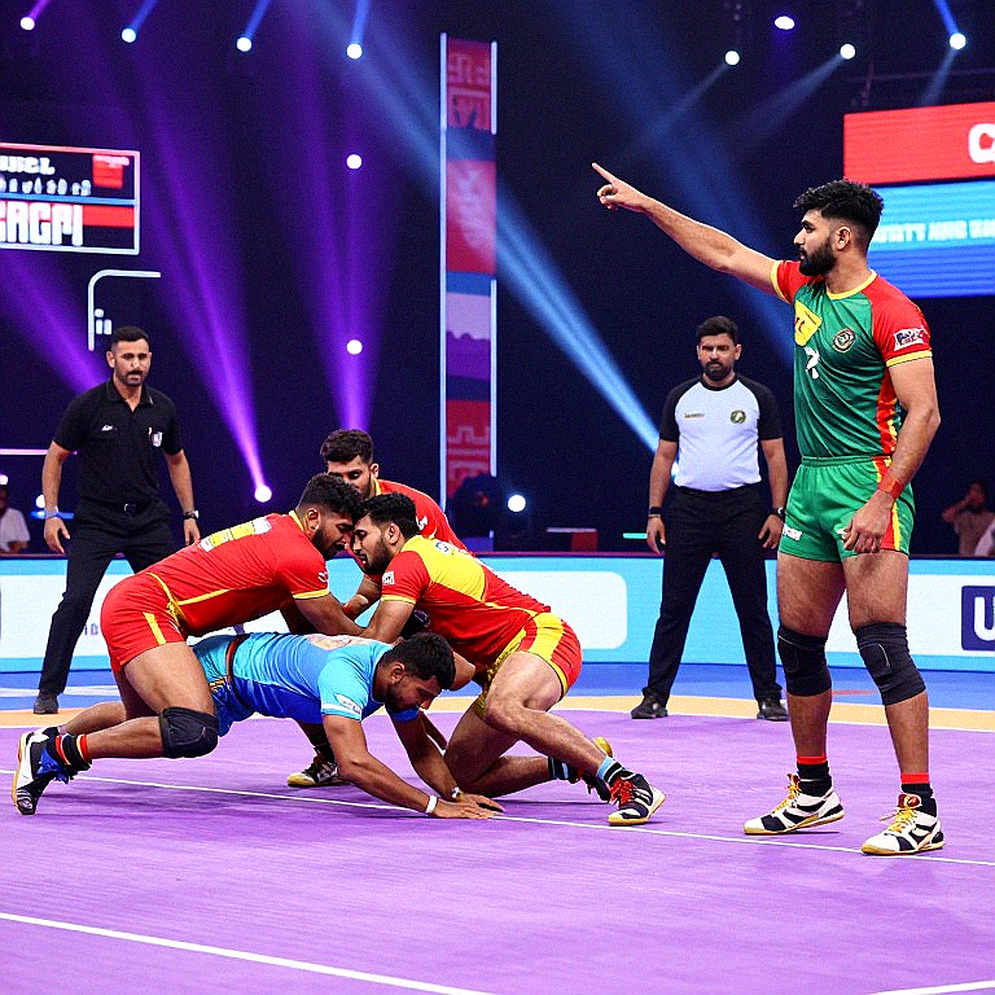

संबंधित खिलाड़ी
अनुशंसित
Commonwealth Kabaddi Championship 2026: Surjeet Singh Captain, Naveen Kumar Vice-Captain — and Three Empty Columns in the Announcement2026-10-22
Ahmedabad’s 62-Match Experiment: India’s Real Commonwealth Kabaddi Test Is on October 292026-10-30
The Empty Slot in Ahmedabad: A Field Cut from 14 to 13, and the Question Nobody Is Answering2026-10-22
Ahmedabad’s First Commonwealth Kabaddi Championship: 62 Matches, 13 Nations and an Unstated Ledger2026-10-22
Commonwealth Kabaddi Championship: Pakistan's last-minute pullout cuts the field from 14 to 13 — and leaves one question unanswered2026-10-22
Kabaddi's Unpriced Market: 138 Rows on a Spreadsheet, and the 139th Row That Was Never Logged2026-10-25
Surjeet Singh Named Captain, Naveen Kumar Vice-Captain: Three Gaps in the Commonwealth Kabaddi Championship 2026 Release2026-10-22